The operational problems SpareTags is built to solve
These are not edge cases. They are the daily reality of spare parts management on most commercial vessels.
Manhours lost searching for spares
When maintenance is needed, the crew often know the spare exists somewhere onboard but cannot find it quickly. SpareTags reduces that search time significantly by giving the officer a searchable location record for every tagged item.
No shore visibility without calling the ship
Superintendents and procurement teams currently have no live picture of what is actually onboard each vessel. They rely on month end reports, stock report or phone calls which are often delayed, incomplete, and inconsistent.
Reactive ordering & duplicated procurement
Without visibility, orders are placed either too late, duplicated, or too early. SpareTags makes reorder flags visible before they become urgent and surfaces fleet-wide stock for potential redistribution.
High crew time on manual administration
Manual stocktaking, requisition preparation, and record-keeping consume significant crew time. IoT-tracked inventory reduces the manual effort involved in maintaining an accurate picture.
Tag. Track. Predict. Optimize — Smarter Spares, Zero Surprises.
Inventory tagging
Every spare in the storeroom is tagged with an IoT tracker.
Issue and return scanning
Item locations are easier to locate and system stops unreported spares being taken out.
Shore dashboard goes live
The shore team can see current stock levels across every vessel that is connected and monitor thresholds.
Reporting and planning
Consumption reports, fleet-wide redistribution suggestions, and requisition preparation are available from the dashboard, enabling the teams for predictive maintenance plans.
What SpareTags gives you
Spare location search
Officers search by part name, number, or category and get the rack and bin location immediately.
Offline capability
The system runs on a local database onboard and syncs when connectivity is available. No operational dependency on internet access.
Integration Ready Architecture
SpareTags is already integrated with one of the industry's longest-established maritime PMS platforms.
Reorder threshold alerts
Items flagged when they fall below a set threshold give procurement teams advance notice rather than an emergency request.
Fleet-wide stock view
The shore dashboard shows stock across all vessels simultaneously. This makes redistribution possible and save significantly on duplicate orders and stress procurements.
Demand planning
Usage history builds over time to support better forward planning and predictive ordering across the fleet.
Where SpareTags creates value
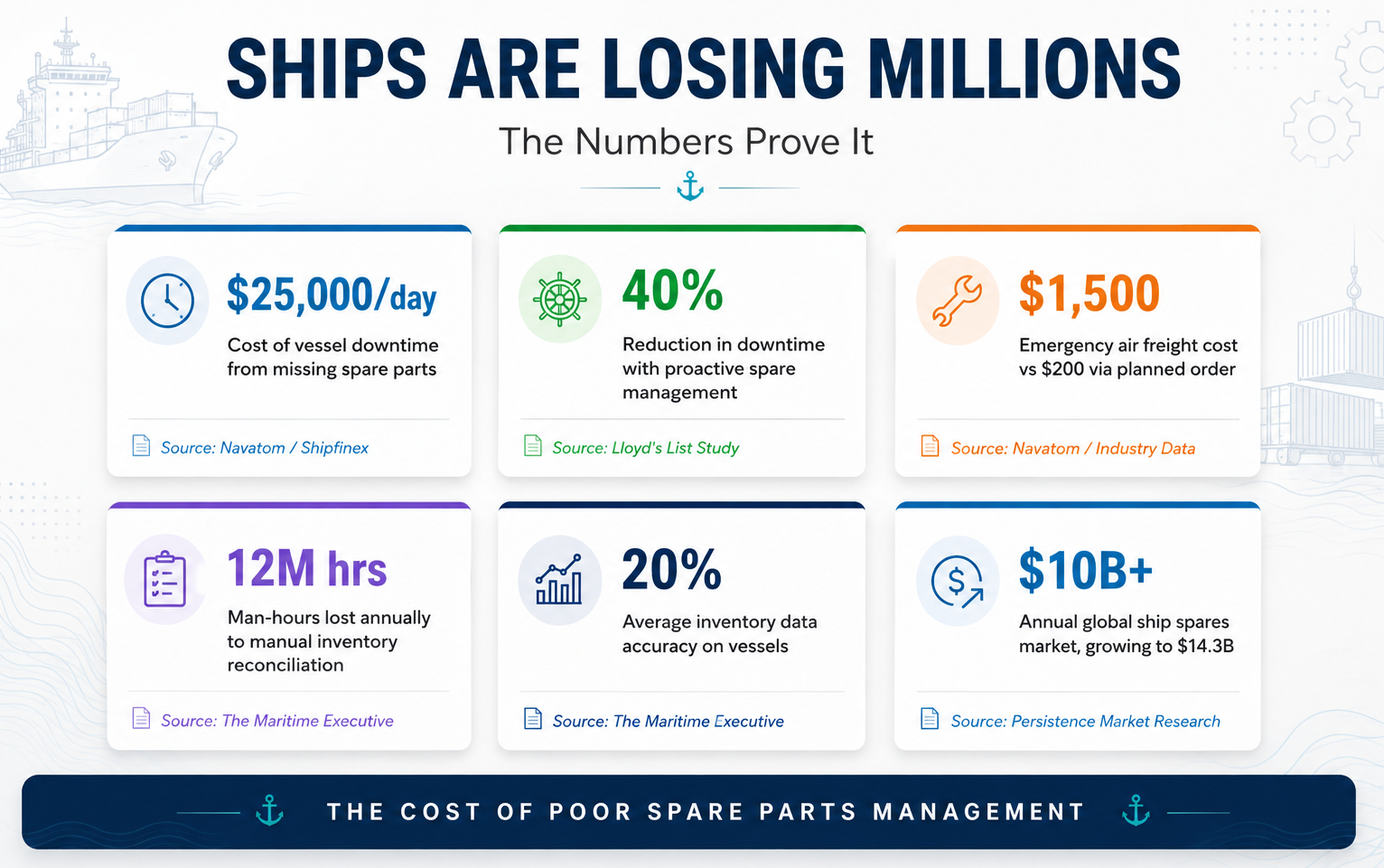
Spare parts management inefficiency shows up as a combination of small but frequent costs: manhours spent searching for items, last-minute orders at premium freight rates, duplicate procurement across a fleet, and crew hours spent on manual stocktaking rather than maintenance work.
The figures shown are indicative annual savings per vessel, based on industry cost benchmarks.
The roles it changes most
"Finding a spare during a job takes longer than the job itself sometimes."
With SpareTags, searching for an item by name or part number returns the rack and bin location immediately.
"I only find out a spare is missing when the ship calls me in a panic."
Reorder flags surface before items hit zero. The shore dashboard gives you the current picture across every vessel.
"Half my urgent orders could have been planned if I had known earlier."
Threshold alerts give advance notice. Fleet-wide visibility makes it possible to redistribute stock between vessels.
"I need to know what we will need across the fleet in the next twelve months."
SpareTags builds a consumption history across the fleet to support predictive demand projections.